Dream Resource Center
Stay updated on DRC events!


The Dream Resource Center (DRC), located in the Ross L. Handy Campus Center, is dedicated to fostering a supportive, inclusive and empowering environment for undocumented, AB 540, DACAmented students and individuals from mixed-status families.
Established in January 2021, the DRC serves as a vital hub of connection and support, staffed by a knowledgeable UndocuLiaison who works closely with students to link them to essential resources, campus and community services and valuable academic and personal development opportunities.
Guided by its mission to expand access to higher education and ensure successful completion, the DRC is committed to breaking down barriers and providing the tools, guidance and encouragement students need to succeed. We strive to create a space where all students — regardless of immigration status — can feel seen, supported and empowered to thrive academically, personally and professionally.
El Dream Resource Center (DRC) es un espacio donde los estudiantes indocumentados, AB 540, beneficiarios de DACA y aquellos de familias de estatus mixto pueden acceder a apoyo, recursos y oportunidades regulares e individualizados para lograr sus objetivos educativos y prosperar independientemente de su estatus migratorio.
Servicios DRC
- Apoyo financiero (asistencia para la solicitud de California Dream Act, accesa ciertas subvenciones, búsqueda de oportunidades de becas)
- Asesoramiento académico
- Cita virtual vía Zoom
- Consultas individuales (no académicas)
- Excursiones educativas
- Refrigerios, suministros y materiales de prueba gratuitos
- Servicios legales gratuitos de inmigración
- Talleres/presentaciones específicas para las necesidades de estos estudiantes
- UndocuAlly formación para empleados
Información del Contacto
Ubicación del DRC: Campus Center (CC), sala 127
Comuníquese con el DRC
(626) 857-4048
drc@citruscollege.edu
@citrusdreamcenter
SPRING 2026 OFFICE HOURS
Feb 17 – Jun 12, 2026
Mon/Thur 8 a.m. to 5 p.m.
Tue/Wed 8 a.m. to 7 p.m.
Fri 8 a.m. to 4:30 p.m.
OFFICE CLOSURE DATES
Feb 13, Feb 16 Presidents Day
Mar 31 Farmworkers Day
May 25 Memorial Day
SPRING BREAK WEEK Apr 13 – Apr 16 from 8 a.m. to 5 p.m. | Apr 17 from 8 a.m. to 4:30 p.m.
DEFINING AND COMING OUT AS UNDOCUMENTED
Who All is Included in the Term "Undocumented"
It broadly includes all immigrants residing in the U.S. without legal status for whom
any of the following are true:
- entered the country with legal status but overstayed their visit
- entered the country without presenting themselves for inspection at an official checkpoint
- has or previously had Deferred Action for Childhood Arrivals (DACA)
- is still in the process of legalizing their immigration status
Note: International students (F-1 student visa) please contact the International Student Center for questions or assistance.
Coming Out as Undocumented
Telling someone you are undocumented can be emotional, cathartic or downright terrifying
— these are stories of several people who chose to and why. Check out these other Immigrants Rising stories of #UndocuHustle, heartbreak and humor from brilliant undocumented storytellers.
STUDENT DATA PROTECTION
Per federal and state laws, Citrus College will not disclose student information for immigration enforcement purposes without a court order or judicial warrant, unless authorized by the student or required by law.
Citrus College is open to all students who meet the minimum requirements for admission regardless of immigration status. Students can be confident that the information students provide us or submit on their admission and financial aid applications will be kept private and confidential and will not put them or their families at risk.
Additionally, Citrus College has developed a protocol and guide to assist staff in responding to any immigration enforcement activities.
For additional information, questions or concerns, please email drc@citruscollege.edu.
- Administrative Procedure 5040 Student Records Directory Information and Privacy
- FERPA Statement
- Guidance for Dealing with ICE on Campus
IMMIGRATION LEGAL SERVICES
Ver la versión en Español del video en YouTube
Immigrant Legal Defense (ILD) is a nonprofit agency that provides FREE immigration legal services to Citrus College students, faculty and staff.
By making an appointment with one of ILD's attorneys, they can help with the following:
- answering any immigration-related questions
- applications for lawful permanent resident status (green card)
- family-based petitions
- initial/renewal DACA applications*
- legal consultations to screen for immigration relief
- U.S. citizenship/naturalization applications*
*Financial assistance is available to pay the USCIS filing fees.
MAKE AN APPOINTMENT
Schedule your appointment via the findyourally.com website. Please search for "Citrus College" under LOCATION and select the "Virtual" (i.e.,
phone or Zoom) option.
Download our guide to know what to expect and prepare for your first appointment.
MEETING SPACE
You can reserve a meeting room with a computer with Zoom access, a printer and a telephone
for your virtual appointment by contacting the DRC by emailing drc@citruscollege.edu or calling (626) 857-4048.
RESOURCES

ILRC Red Cards
The Immigrant Legal Resource Center (ILRC) Red Cards (available in various languages) educate immigrants on their rights and help assert
them in many situations, such as when ICE agents go to a home. Students can also find
printed Red Cards at the DRC.
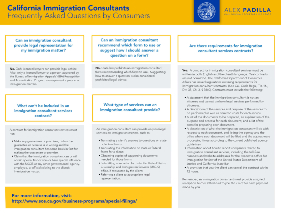
Avoid Immigration Scams
Immigration laws and procedures are complicated. Review the ILRC Avoiding Fraud page to help protect yourself from scams. Also, a PDF brochure of frequently asked questions is available for download for those seeking nonlegal services from immigration consultants (who are not licensed
lawyers). Both community resources are available in English and Spanish.
GRANTS
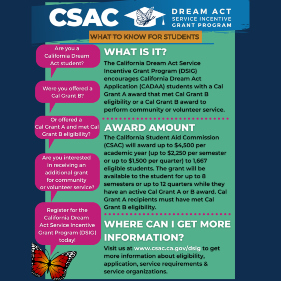
The California Dream Act Service Incentive Grant (DSIG) program encourages California Dream Act students with a Cal Grant B award (or a Cal Grant A award that met Cal Grant B eligibility) to perform community or volunteer service.
The California Student Aid Commission (CSAC) awards students who complete the required service hours up to $4,500 per academic year.
Program Details
- Award: Up to $4,500 per academic year ($2,250 per semester or $1,500 per quarter)
- Duration: Available for up to eight semesters or 12 quarters while the student maintains an active Cal Grant A or B award
- Separate Application Required? Yes – Students must submit a DSIG application for each award year in addition to the CADAA.
- Application Start and Deadline: DSIG Applications are available starting July 1 and accepted until June 30 of the academic year or until all 1,667 awards are exhausted, whichever comes first. The CADAA should be submitted by the priority deadline for state aid.
For eligibility, requirements and other important information, visit the California Student Aid Commission's DSIG web page.
The DRC can provide information about the CSAC program and assist eligible students with the application process and service organization search by appointment with the UndocuLiaison.
This grant is intended to provide direct aid to assist undocumented students experiencing hardship or financial need preventing them from completing their courses at Citrus College. It is awarded on a first-come, first-served basis up to once per academic year.
To access this resource, students must meet with the UndocuLiaison.
CALIFORNIA RESIDENCY, AB 540, CALIFORNIA DREAM ACT
If you have not done so already, there are two important steps as an undocumented
student you will need to complete if you are eligible:
- Establish California residency (for tuition purposes) or submit the Nonresident Tuition Exemption (commonly known as the AB 540 affidavit)
- Apply for the California Dream Act
For questions/assistance with these steps, please contact the Dream Resource Center by emailing drc@citruscollege.edu or calling (626) 914-8546 to make an appointment.
Every student's California residency is determined by the college and is based on the information they submitted on their application for admission.
NOTE: California residency for tuition purposes is different from U.S. citizenship/permanent resident status.
Students will receive an email from admissions and records notifying them of their residency status. The college will determine whether a student is a California resident or nonresident (for tuition purposes). Students who are classified as nonresidents:
- are not eligible for state-based financial aid
- cannot participate in programs for California residents
- pay nonresident tuition
HOW TO PETITION FOR RECLASSIFICATION
DACA recipients can establish California residency and change their classification
if they have lived in the state for one year plus one day before the semester begins
and can demonstrate they intend to remain a California resident.
To petition for reclassification as a DACA recipient at Citrus College, students must submit the Residency Reclassification Petition form with the required proof.
Undocumented students who do not have DACA may be eligible to apply for the Nonresident Tuition Exemption (AB 540 affidavit). Please refer to the next tab below.
Assembly Bill (AB) 540 is a California law passed in 2001 that exempts certain students, including undocumented students, who meet the eligibility requirements from paying nonresident tuition and allows access to some state-based financial aid and programs.
HOW TO APPLY
To apply for the AB 540 affidavit at Citrus College, eligible students must submit
the Nonresident Tuition Exemption application and a copy of their official transcripts to admissions and records. Review a detailed breakdown of the requirements.
Undocumented students who do not currently meet the AB 540 requirements may be able to build up their eligibility. The In-State Tuition Tool on the Immigrants Rising website can help students determine if they are eligible before applying.
The California Dream Act is a state-based financial aid program comprising two California laws (AB 130 and AB 131) that allow AB 540 eligible undocumented (DACA and non-DACA), Temporary Protected Status (TPS) and U visa students to apply for:
- certain scholarships
- financial aid fee deferments
- state-funded grants (e.g., California College Promise Grant and Cal Grants)
- state programs (e.g., EOPS)
Students do not need to be DACA recipients to apply for the California Dream Act. DACA is a federal program and has no bearing on it. Use this guide from the Immigrants Rising website to learn the difference between them and who is eligible for each.
NOTE: DACA recipients should be filling out the California Dream Act Application (CADAA) if they are eligible, not the FAFSA.
HOW TO APPLY
The priority filing deadline for CADAA is from October 1 to March 2. Students can
apply by visiting California Student Aid Commission CA Dram Act website to ensure they are considered for all state-based financial aid.
Students can sign up to attend an application assistance workshop hosted by the college's financial aid department. More Cash for College workshop dates are also offered through the California Student Aid Commission (CSAC).
IMPORTANT: DACA recipients who establish California residency do not need to submit the AB 540 affidavit but must meet the AB 540 requirements to receive their financial aid award.
IS IT SAFE TO APPLY FOR THE CALIFORNIA DREAM ACT?
CSAC released a joint statement with the California Department of Education stating the information students provide
them is not shared with the federal government or used for immigration enforcement
purposes and will be protected to the fullest extent of the law.
DACA INFORMATION, UPDATES
Stay informed on DACA renewals, status changes and policy updates to protect your
rights and maintain access to education and work opportunities.
DACA is a federal executive memorandum (not law) that provides undocumented youth who came to the U.S. as children (before their 16th birthday) and who meet specific criteria:
- temporary relief from deportation (deferred action)
- work authorization
- with this, they can apply for a Social Security number
DACA is subject to renewal every two years and does not:
- grant eligibility for federal student aid
- grant lawful status
- provide a path to citizenship
WHERE DOES DACA CURRENTLY STAND?
Although it was rescinded in 2017, multiple lawsuits have since upheld part of the
program. As of early 2025, courts continue to allow renewals for current DACA holders,
but new applications remain paused. The program's long-term future remains unsettled,
so staying updated is critical.
You are strongly encourage to stay updated. You may find the most recent updates and information on the following DACA-related websites:
- Immigrant Legal Resource Center (ILRC)
- Immigrants Rising Updates
- National Immigration Law Center (NILC)
- U.S. Citizenship and Immigration Services (USCIS)
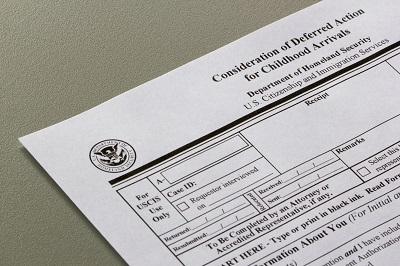
IMPORTANT: It is recommended that applicants consult an immigration attorney or United States Department of Justice (DOJ) accredited representative before applying. This searchable online directory can help students find free and low-cost legal help: https://www.immigrationlawhelp.org
RENEWAL APPLICANTS
Per USCIS, if you currently have DACA and it has expired or was terminated, you are
eligible to request a renewal if you meet the following criteria:
- Must meet the initial 2012 DACA guidelines.
- Did not depart the U.S. on or after August 15, 2012 without advance parole
- Have continuously resided in the U.S. since the most recent approved DACA request
- Have not been convicted of a felony, significant misdemeanor or three or more misdemeanors and do not pose a threat to national security or public safety

Source: USCIS
ADDITIONAL RESOURCES
IMMIGRANTS RISING SERVICES
California In-State Tuition Tool
Mental Health Connector
Wellness Support Groups
HEALTH, MENTAL WELLNESS
American Foundation for Suicide Prevention
call or text 988 or text TALK to 741741
California Youth Crisis Line 24/7
call or text (800) 843-5200