Dr. Floyd S. Hayden
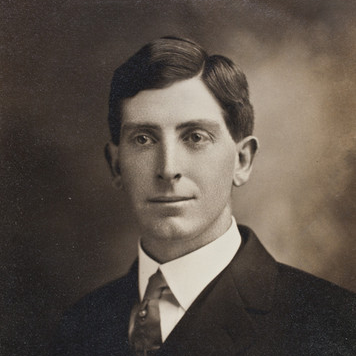 In 1914, Floyd Smith Hayden, an idealist from Indiana, took charge of Citrus Union
High School as principal after serving five years with the Chino schools, two years
as vice principal at Chaffey Union High School and completing graduate studies at
the University of Chicago. A licensed preacher and scholar of English and American
literature, Hayden held strong convictions about education, democracy and the role
of public schools in society. Both compassionate and steadfast, he devoted himself
to his family, his students and his staff. For the next 31 years, he led Citrus with
vision and authority — a tenure unmatched in the institution's history.
In 1914, Floyd Smith Hayden, an idealist from Indiana, took charge of Citrus Union
High School as principal after serving five years with the Chino schools, two years
as vice principal at Chaffey Union High School and completing graduate studies at
the University of Chicago. A licensed preacher and scholar of English and American
literature, Hayden held strong convictions about education, democracy and the role
of public schools in society. Both compassionate and steadfast, he devoted himself
to his family, his students and his staff. For the next 31 years, he led Citrus with
vision and authority — a tenure unmatched in the institution's history.
According to his daughter, Margaret Hayden Rector, Hayden was feisty and methodical, tireless in his work and meticulous in every detail, yet cautious and disciplined when it came to district spending. His days began at dawn, feeding the chickens, shoveling coal into the furnace and handling chores around his Azusa home before heading to the high school. Many evenings ended with visits from parents who sought his counsel on matters concerning their children's schooling or conduct.
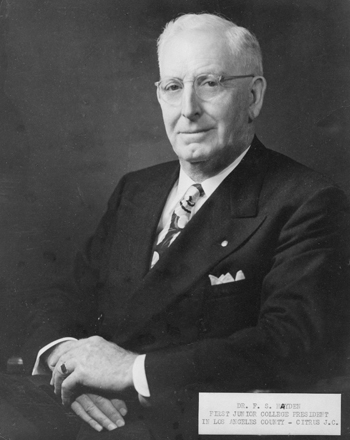 A man of conviction, Hayden stood firmly by his beliefs, even when they conflicted
with prevailing opinions. He chose to live in a neighborhood that many members of
the board of trustees and faculty regarded as undesirable, seeing his decision as
an expression of integrity, humility and equality. He maintained steady control of
the institution and expected his faculty to uphold the same professional and moral
standards that guided his own conduct, both on campus and within the broader community.
A man of conviction, Hayden stood firmly by his beliefs, even when they conflicted
with prevailing opinions. He chose to live in a neighborhood that many members of
the board of trustees and faculty regarded as undesirable, seeing his decision as
an expression of integrity, humility and equality. He maintained steady control of
the institution and expected his faculty to uphold the same professional and moral
standards that guided his own conduct, both on campus and within the broader community.
Inspired by his ideals of education and democratic opportunity, Principal Hayden championed the idea of creating a junior college that would expand access to higher learning for local students. California law had permitted the extension of high school programs to include two years of postsecondary study as early as 1907, and Hayden had studied the early development of junior colleges during his time at the University of Chicago. His vision was realized on the evening of June 5, 1915, when, at approximately 7:30 p.m., the board of trustees formally voted to establish Citrus Junior College.
"My father was absolutely devoted to those two years of free education," reflected Margaret Hayden Rector. "He was proud to establish Citrus in 1915 ... his vision was that, economically, the student had a right to two free years of college."
When Citrus Junior College was founded, it became the eleventh such institution in California and the fourth within Los Angeles County. Over the next decade, a number of early junior colleges — including Long Beach (1916), Hollywood (1919), Los Angeles and Placer (1920), San Diego (1927) and Santa Barbara (1928) — ceased operation. With their closure, Citrus College achieved lasting recognition as the fifth oldest junior/community college in the state and the oldest continuously operating institution of its kind in Los Angeles County.
Dr. Floyd Smith Hayden, educator
August 27, 1881 – June 14, 1957
Source: Clark, Alfred Paul. Citrus Speaks. Glendora, Calif.: Citrus Alumni Association and Citrus College Foundation, 1994.