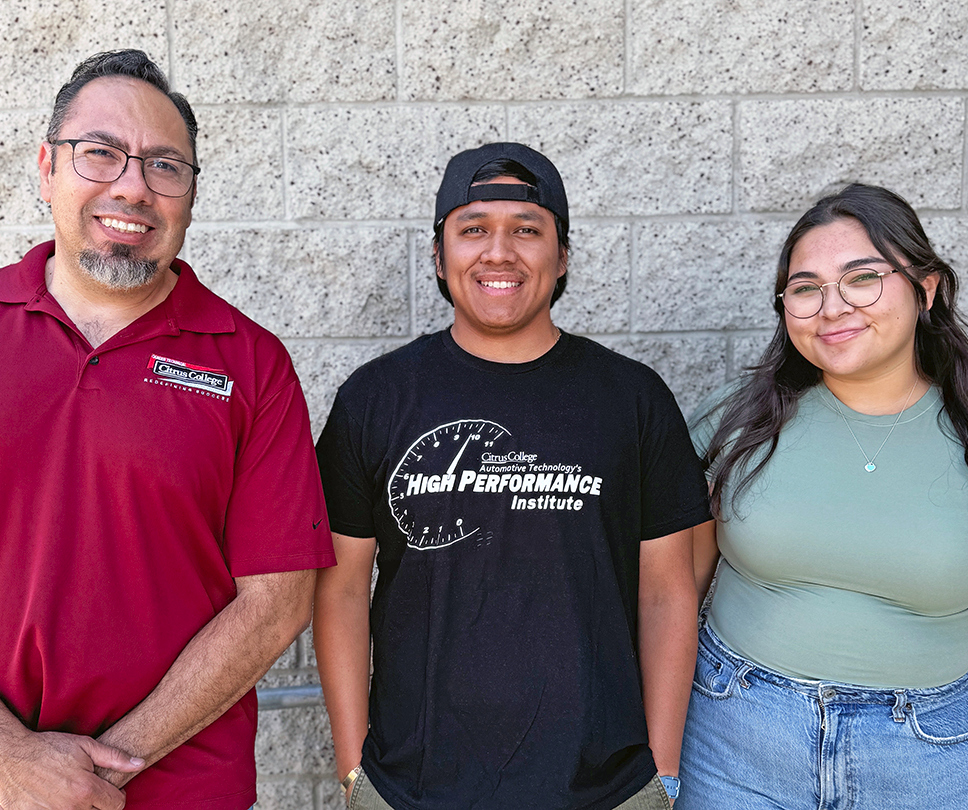
Congratulations to several Citrus College STEM students, alumni and faculty, whose research on plasma-enhanced combustion was recently published in "Fuel," a peer-reviewed scientific journal focused on the science and technology of fuels.
The aim of the research was to determine how plasma technology could help reduce the level of pollutants emitted from the burning of hydrogen in car engines. While hydrogen is one of the leading candidates among all carbon-free fuels, its use in engines can lead to high emissions of nitrogen oxides (NOx).
The plasma technology used in the research was originally created by Dr. Martin Gundersen, a Citrus Union High School alumnus who, for decades, taught and conducted research at the University of Southern California (USC). Though he has since retired, Gundersen's research continues at USC. Citrus College instructor Mariano Rubio, who is currently pursuing his Ph.D. at USC, invited several Citrus College students to join in on the project.
"It's been an exciting time having our students at the cutting edge of research," Rubio said.
Some of those involved in the research were Citrus College graduates Victor Chen and Oscar Hernandez, who became attached to the project through the Citrus College Summer Research Experience program. Other contributors included current students Joshua Tobar Lam, Aimee Ortiz-Ramirez and Travis Riggs.
Much of the experience was hands-on, Tobar Lam recounts. His responsibility was to make sure that the correct amount of hydrogen was introduced into the natural gas engine at a precise pressure. His other job was to apply a load onto the engine as more hydrogen was injected.
"The most important part was to make sure that all gas tanks were closed, along with turning off all electrical sources and flames that could potentially ignite," he said.
Ortiz-Ramirez also played a major role in the research, serving as a data analyst.
"As the experiment was running, I would have to look at values that were given on a Horiba [device], which measured the levels of NOx," she said.
Ultimately, the research showed that the plasma-enhanced combustion of hydrogen leads to higher power output and more stable operations, in addition to lower NOx emissions.
On behalf of the campus community, we want to congratulate all of our campus community members who were involved in this project. We couldn't be prouder!
To read more about the research, review the full length article in Science Direct.
This student spotlight was originally shared on the official Citrus College Facebook account on Wednesday, November 20, 2024.