Student Conduct and Discipline
An essential part of fulfilling the college's mission is providing a student discipline process that promotes student accountability and social responsibility, as well as maintaining a college environment that is respectful, inclusive, collegial and free from intimidation, threats, coercion or violence.
The dean of students provides information regarding standards of conduct, academic dishonesty codes, campus policies and procedures to facilitate the resolution of college-related challenges encountered in pursuing due process. Student discipline procedures facilitate the educational mission of the college. Student affairs employs a variety of methods in adjudicating student discipline cases and works collaboratively with various Citrus College partners, such as student services, academic affairs and community representatives, to assess behaviors of concern.
Additionally, student affairs is committed to implementing California State Education Code Sections 66300, 66301, 72122 and 76030. The purpose of the student discipline procedures (AP 5520) is to provide a prompt and equitable means to address violations of the standards of conduct (BP 5500), which guarantees students their due process rights required per state and federal constitutional protections.
Students, faculty, staff and administration are encouraged to explore this site's links in order to obtain further information.
Discipline Hearing Overview and Training Materials
Students involved in disciplinary proceedings have the right to be assisted by an advisor of their choice or to have one appointed to them by the college. With the student's written consent via this online form, the advisor may receive updates during the adjudication process and participate in the hearing as an advisor or advocate.
If a student elects to bring an advocate or advisor who is also licensed as an attorney, the student must give the student affairs office five days notice and the name, phone number and e-mail address of the attorney. The role of the attorney in the student disciplinary process remains limited to that of an advisor or advocate.
The advisors and advocates shall not:
- address the hearing chair, committee members, district witnesses or the district representative to respond on behalf of the student;
- ask questions about the case or its findings; or
- coach the student on what to say or what to not say during the disciplinary hearing.
An advisor or advocate who disrupts the hearing proceedings (as determined by the dean of students or hearing committee chair) may be asked to leave. Hearings will not be delayed due to an advocate or advisor not showing up or attending the proceedings late.
A student may only have one person accompany them during a disciplinary hearing and they may choose whether this person will serve as an advisor or advocate. The student's advisor or advocate will have access to training materials regarding the college's adjudication procedures. The training materials and video are available in the accordion tabs below.
If a student chooses to have an advisor or advocate (see definitions below), they must complete this online form.
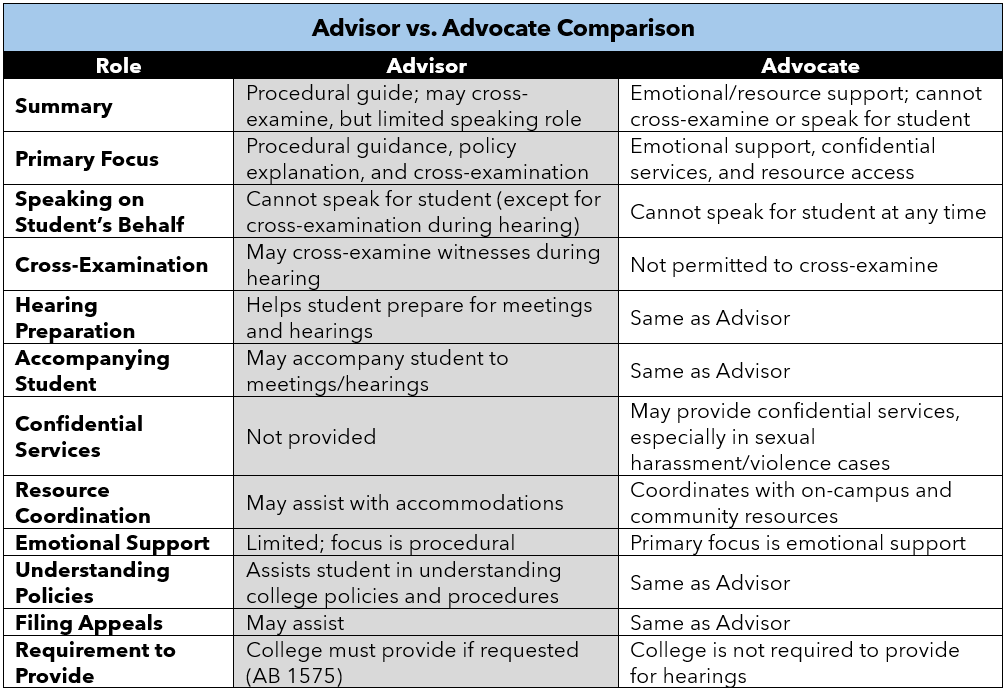
ADVISOR vs. ADVOCATE COMPAIRSON
- Summary
- Advisor: Procedural guide; may cross-examine, but limited speaking role
- Advocate: Emotional/resource support; cannot cross-examine or speak for student
- Primary Focus
- Advisor: Procedural guidance, policy explanation and cross-examination
- Advocate: Emotional support, confidential services and resource access
- Speaking on Student's Behalf
- Advisor: Cannot speak for student (except for cross-examination during hearing)
- Advocate: Cannot speak for student at any time
- Cross-Examination
- Advisor: May cross-examine witnesses during hearing
- Advocate: Not permitted to cross-examine
- Hearing Preparation
- Advisor: Helps student prepare for meetings and hearings
- Advocate: Same as advisor
- Accompanying Student
- Advisor: May accompany student to meetings/hearings
- Advocate: Same as advisor
- Confidential Services
- Advisor: Not provided
- Advocate: May provide confidential services, especially in sexual harassment/violence cases
- Resource Coordination
- Advisor: May assist with accommodations
- Advocate: Coordinates with on-campus and community resources
- Emotional Support
- Advisor: Limited; focus is procedural
- Advocate: Primary focus is emotional support
- Understanding Policies
- Advisor: Assists student in understanding college policies and procedures
- Advocate: Same as advisor
- Filing Appeals
- Advisor: May assist
- Advocate: Same as advisor
- Requirement to Provide
- Advisor: College must provide if requested (AB 1575)
- Advocate: College is not required to provide for hearings
KEY DIFFERENCES
-
Advisors can cross-examine witnesses and provide procedural guidance, but cannot otherwise speak on the student's behalf.
-
Advocates focus on emotional support and resource access, do not cross-examine or speak for the student and may offer confidential services in sensitive cases.
-
Colleges must provide an advisor if requested, but are not required to provide an advocate for disciplinary hearings.
ADVISORS
An advisor accompanies a student to meetings related to the hearing process and focuses on procedural guidance related to the college's disciplinary process but may not speak on the student's behalf. However, the advisor may cross-examine on the student's behalf. Advisors do not have any other speaking roles during the hearing.
Advisors may assist a student with:
- hearing preparation.
- accompanying the student to meetings or hearings related to the disciplinary process.
- helping the student prepare for meetings or hearings.
- assisting the student in understanding the college policies and procedures.
- conducting cross-examination during the disciplinary hearing.
- conferring with the student before or after proceedings.
- filing appeals.
- accessing accommodations.
ADVOCATES
An advocate accompanies a student to meetings related to the hearing process and focuses on providing emotional support and access to resources during the disciplinary process but may not speak on the student's behalf or cross-examine district witnesses.
Advocates typically assist a student with:
- confidential services to students involved in cases of sexual harassment or sexual violence.
- coordinating with on-campus resources and community-based organizations.
- emotional support.
- helping the student prepare for meetings or hearings.
- accompanying the student to meetings or hearings related to the disciplinary process as a support person.
- assisting the student in understanding college policies and procedures.
- conferring with the student before or after proceedings.
- filing appeals.
- accessing accommodations.
Please note that the college is not required to provide an advocate for disciplinary hearings.
Citrus College Board Policy 5500 Standards of Conduct
This board policy provides information regarding the college's standards of conduct
and the various violations.
Citrus College Administrative Procedure 5520 Student Discipline
This administrative procedure provides information regarding the college's disciplinary
hearing process, which outlines due process rights for students and includes definitions
of various terms.
Video on YouTube: Discipline Hearings Decoded: A Guide for Advisors and Advocates
This video outlines how a college disciplinary hearing is conducted as well as the
standard of evidence required to find a student responsible for violating the standards
of conduct.
updated September 23, 2025